
What Is a Neural Network? (Machine Learning Explained Simply for Beginners)

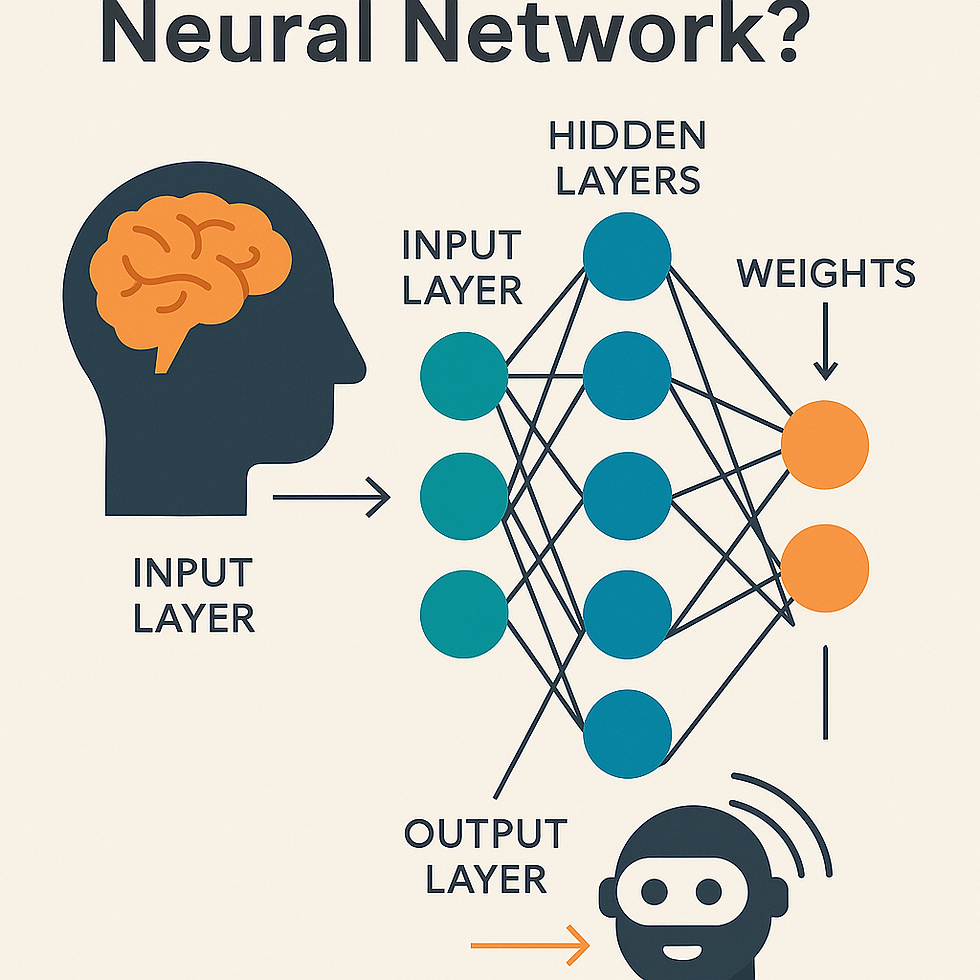
Neural networks are the “brains” behind many AI systems like ChatGPT , enabling computers to recognize patterns and learn from data that is provided to them.
Artificial Intelligence is all around us — from voice assistants on our phones and smart speakers to movie recommendations on Netflix, self-driving cars, and even medical diagnostic tools. At the heart of many of these breakthroughs lies a powerful concept: neural networks. This AI for beginners guide will demystify what neural networks are, how neural networks work, and how they learn, all in simple terms. In short, a neural network is a type of machine learning model inspired by the human brain, designed to recognize patterns and make predictions
How Neural Networks Work (Let's Dive in...)
Think of a neural network as a web of interconnected “neurons” (also called nodes). It’s modeled after the way brain cells (neurons) connect and communicate. Each neuron in the network is a very simple processor that only performs a basic calculation. However, when you connect thousands or millions of these artificial neurons together, they can work as a team to solve complex problems. In essence, a neural network functions like a miniature brain: you feed it some input, the information gets passed through many connections and layers of neurons, and comes out as output.
Layers: Neural networks are organized in layers. The input layer is where data enters the network (imagine this as the neurons that first “see” or receive the information). Then come one or more hidden layers , this is where the “magic” happens. In the hidden layers, each neuron looks at the data it receives, performs a simple operation, and passes it on. These layers collectively find patterns or features in the data. Finally, there’s the output layer, which produces the result. For example, if the task is to recognize an image of a cat, the input layer takes in the image pixels, the hidden layers gradually detect features (like edges, shapes, fur patterns), and the output layer gives the prediction (e.g. “this is a cat”). Each connection between neurons has a weight, which is just a number that indicates how strongly one neuron’s output should influence the next neuron. Initially, these weights are set randomly, but they will be adjusted as the network learns.
Analogy: You can think of a neural network as an assembly line for information. Imagine an assembly line in a factory: each worker (neuron) does a simple task, then passes the product to the next station. Individually, each worker’s task is simple, but together they build something complex. Similarly, each neuron does a small calculation and passes it on; together, the network can accomplish sophisticated tasks like understanding speech or recognizing images. Another analogy is to picture neurons as filters or checkpoints: the input passes through a series of filters (layers) that progressively refine the information, until an answer is produced at the end.
How Neural Networks Learn (Training and Weights)
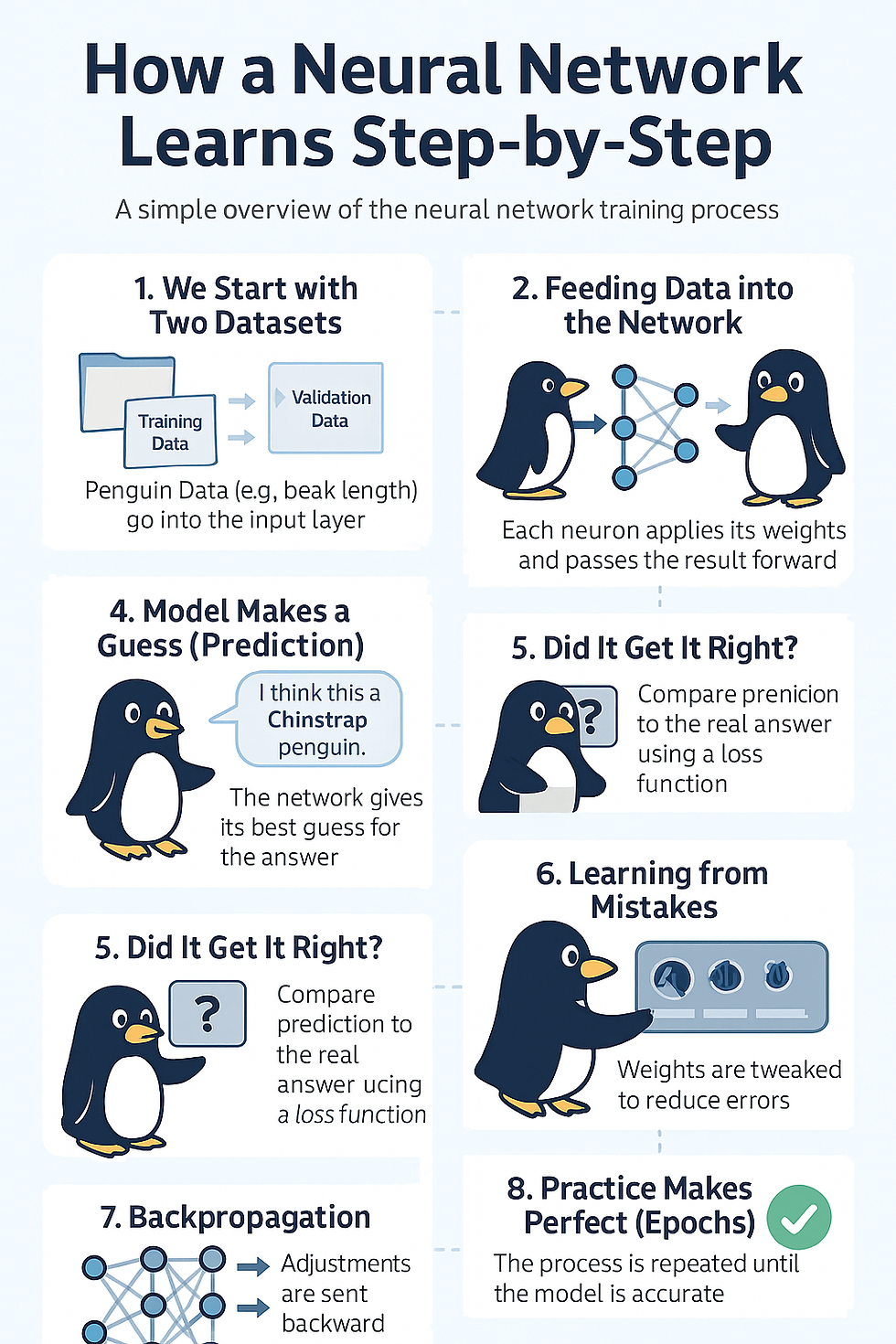
Neural networks learn through a lot of practice and feedback, very much like how humans learn a new skill. When we say a neural network is “trained,” it means we show it many examples and let it adjust itself to improve over time. This training process involves tuning those connection weights we mentioned above.
Here’s a simple way to understand it: training a neural network is like teaching a child (or a pet). Suppose you’re teaching a dog to fetch a ball. At first, the dog might not even understand what to do. You guide it, maybe show it the ball, and give encouragement or a treat when it gets closer to the right behavior. Over many tries, the dog learns that bringing the ball = reward, and it gets better at fetching. In the same way, a neural network learns by trial and error. Initially, it makes random or uninformed guesses. For each example it tries (say, guessing what an image is), we check the result against the correct answer. If it’s wrong, the network adjusts its internal weights (its “knowledge”) a little bit in the right direction.If it’s right, those connections are reinforced. This adjustment process is repeated thousands or millions of times with many examples, a method often referred to as a feedback loop. Over time, the neural network gradually “fine-tunes” its weights to improve its accuracy by essentially learning from its mistakes.
Analogy: One expert described this learning process with a great analogy: training a neural network is like teaching a dog a new trick. Through repetition and positive reinforcement, the dog slowly improves at the trick.Similarly, the neural network tweaks its “weights” (parameters) with each iteration to get better at its task. Another analogy is a student learning math problems: at first, they might guess, then see the correct answer and adjust their approach. With each corrected mistake, the student’s “weights” in their brain are adjusted, and they get closer to the correct method. In neural networks, this is exactly what happens through a technique called backpropagation (though we won’t dive into the math here) , the network figures out how to correct its errors by nudging the weights in the right direction a little bit each time.
After training, we end up with a neural network that has learned from lots of examples. Now, when you give it new data that it hasn’t seen before, it can make a prediction or decision based on what it has learned. For instance, a trained neural network that has learned to recognize cats can look at a new picture and confidently say “that’s a cat” because it has internalized the patterns of what cats look like. In short, the network has generalized from its training data to handle new situations.
Real-World Applications of Neural Networks
Neural networks might sound abstract, but they are behind many technologies you use daily. Here are a few real-world applications of neural networks:
Image Recognition: Neural networks can identify objects, animals, or people in photos. This powers features like face recognition (e.g. tagging friends in pictures on social media) and helps doctors spot abnormalities in medical images like X-rays.
Language and Chatbots: Neural networks are the brains behind modern language apps. For example, ChatGPT (the AI chatbot you may have heard about) is driven by a large neural network that has learned to generate human-like text. Neural networks enable language translation services (like translating English to Spanish) and virtual assistants (such as Siri or Alexa) to understand and respond to your speech.
Recommendation Systems: Ever wonder how Netflix suggests what to watch next or how Amazon knows what you might want to buy? Neural network models learn your preferences and behavior, then predict other movies or products you’ll like. They look for patterns in your past choices to make personalized recommendations.
Self-Driving Cars: Neural networks help autonomous cars make sense of sensor data. They assist in vision tasks like recognizing traffic lights, pedestrians, and road signs from camera images, as well as in decision-making (when to turn, accelerate, or brake) based on learned driving patterns.
These examples only scratch the surface. From predicting stock prices to detecting email spam, neural networks are incredibly versatile. They excel at pattern recognition, which is why they’re used in so many domains.Whenever there’s a need to analyze complex data and make a prediction or classification, there’s a good chance neural networks are involved behind the scenes.
In summary, what is a neural network?
It’s essentially a computer model inspired by the human brain that learns to recognize patterns and make decisions by example. We’ve explained how neural networks work in simple terms: they have layers of connected “neurons” that process data gradually, and they learn by adjusting their connections through trial and error (much like how you would learn a new skill through practice and feedback). This is machine learning explained simply,the machine (computer) learns from data rather than being explicitly programmed with fixed rules.
Neural networks might sound complex, but the core idea is approachable: lots of simple parts working together can do something very smart. They have become the backbone of modern AI, powering everything from the apps on your phone to advancements in science and medicine. As AI technology continues to evolve, neural networks will remain a key driving force, helping computers become better at tasks that once seemed uniquely human.
Keep in mind, you don’t need a technical background to appreciate the impact of neural networks. Hopefully, this beginner-friendly overview has made the concept clearer. Whether it’s your smartphone suggesting the next word in a text or a car driving itself, now you know that neural networks inspired by our very own brains that are doing the heavy lifting, learning step by step to make our world a bit smarter.


Comments